Communicating with whales through AI?
Introduction
The increasing availability of artificial intelligence (AI) may also have repercussions on the way conservation is applied in the future. Of particular interest in this regard is the way different whale species communicate with each other. Already in the 1960s, Roger Payne was fundamental in catalysing the ‘Save the whales’ movement when he discovered and promoted the way humpback whales sing. The ‘Songs of the humpback whale’, released in 1970, became prominent elements in the children’s rooms of the West, manifesting the untouchable status of whales as intelligent and cultural beings (Sellheim, 2023). While humpbacks are the most known species to ‘sing’, also other whale species have developed means of communication that may be of interest to humans, such as the sperm whale. And it is this species which through its clicking sounds as a tool for echolocation has attracted the attention of an international team of researchers, aiming to decipher these sounds through AI.
The sounds of whales
Ever since whales have been studies in more depths and in regard to the way they communicate, interests in these species has not waned. To the contrary. The whale songs recorded by Roger Payne showed clearly discernible patters that some have interpreted to mean that these songs are fraught with meaning. Whitehead and Rendell (2015, pp. 77–78) describe the song structure in the following way:
“A song cycle contains about eight ‘themes’, and these have a distinctive, and invariant, order: theme I is followed by theme II which is followed by theme III, and so on. When the cycle is complete, theme I follows theme VIII, usually without a pause. Then we hear theme II, and so on. Because it is a continuous cycle, designating one of the themes as ‘theme I’ is largely arbitrary, although the whales usually choose the end of a particular theme in order to come to the surface to breathe. Each theme consists of a number of nearly identical ‘phrases’. The most flexible part of the song is in the number of phrases in each theme.”
In other words, the sounds of humpback whales are not merely arbitrary sounds, but appear to carry a certain message that enables them to coordinate their movements. The ‘song’ is consequently better understood to mean ‘language’. A similar observation was made concerning sperm whales. While it has been clear for some time that the clicks are subdivided into smaller units, called ‘codas’, the actual meaning of these clicks has not been fully understood. Peterson (2011, p. 249), for instance, writes that slow-click vocalisation of male sperm whales are “a call to fertile adult females, probably, and a warning to other adult males.”
Whitehead and Rendell (2015, p. 150) note that contrary to orcas who use clicks for echolocation and whistles or pulsed calls for communication, sperm whales use clicks “for just about everything.” Apart from the codas, which is reminiscent of morse code, the characteristic spermaceti organ which is responsible for making the clicks enables the whale to create other clicking sounds such as creaks or the aforementioned powerful slow-click vocalisation that can also be heard through the hull of a ship.
What has become clear is that different groups of sperm whales use different variations of codas, having prompted some to even speak of ‘dialects’ (e.g. Rendell et al., 2012). Interestingly, however, in the North Atlantic, even though different dialects exist, groups using these dialects extend over a significantly larger geographical region than in the Pacific. What this means is that in the Atlantic, dialects can more easily be associated with geographical differences whereas in the Pacific, or more precisely surrounding Galápagos, sperm whales share the same waters but still may use different dialects. These ‘clans’ therefore appear to consider it significantly more important to differentiate themselves from each other than in the Atlantic. One reason for this might related to the availability of squids, the main food source of sperm whales, the congested abundance of which might lead to different sperm whale clans overlapping and interacting, therefore fostering their distinctive dialects within the same geographical region (Whitehead & Rendell, 2015, p. 154).
What this rather sophisticated mode of communication meant in the past was rather recently considered in a study published in Biology Letters (Whitehead, Smith & Rendell, 2021). Here it was shown that during the early years of Pacific commercial whaling for sperm whales, whale catches dropped by around 58%. This massive drop cannot be explained by declining population levels nor can it be explained by less skilled whalers. Instead, the authors maintain, sperm whales quickly learnt how to adapt to whaling and to develop evasive action. Since the whales live in rather small social groups and due to the fact that their communication is rather far advanced, this allowed them to develop evasive action and to communicate this to other individuals in the social group. ‘Word’, so to speak, then spread in the Pacific, allowing larger numbers of sperm whale clans to avoid being targeted by commercial whalers by fleeing upwind or even by attacking the whale boats. Arguably, the story of Moby Dick may describe precisely this behaviour.
Artificial intelligence as a tool to speak to whales?
In light of the increasing role AI plays in and for modern societies, also cetacean science has started to make use of this new technology. In 2020, the Project CETI was formed in order to better understand the language of sperm whales and to increase conservation efforts, especially in the Caribbean nation of Dominica. The project comprises a large number of linguists, ocean biologists, roboticists, acousticians and cryptographers in order to develop AI tools to understand sperm whales and the way they communicate, especially in light of different threats. Using so-called ‘arrays’ that are attached to the whale, underwater drones, underwater drifters and aerial drones, CETI analyses the different sounds made by sperm whales during different phases of their lives.
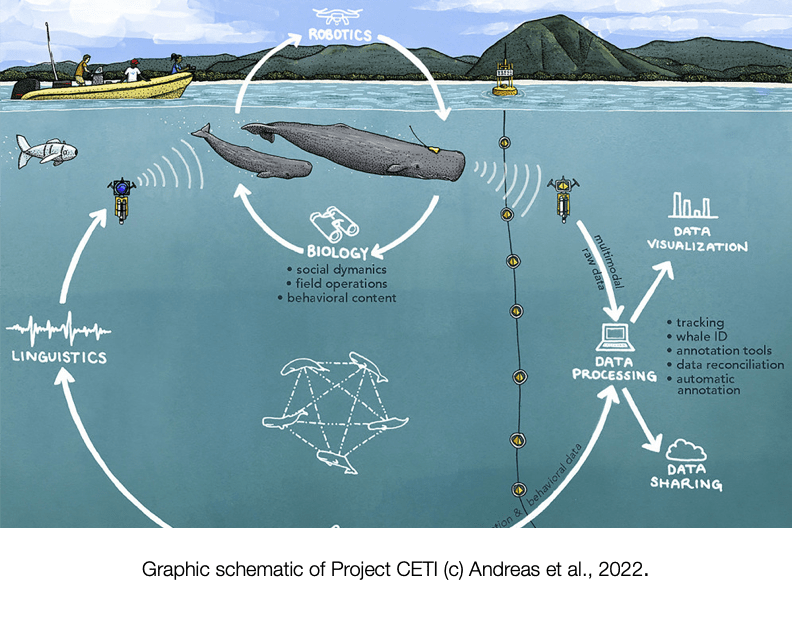
As a first result, National Geographic reports that the first ‘word’ may have been deciphered: a signal the animals use to initiate diving (Langer, 2023). As a preliminary result, however, it appears that sperm whale communication is significantly more complex than was presumed earlier. While it appeared that they use merely around 3 codas, it has now become clear that their communication may be even reaching a level of complexity similar to that of the human language. By linking behaviour and the analysis of millions of recorded codas, Project CETI aims to find patterns based on machine learning.
Naturally, the wish to talk to non-human species has been part of human imagination for decades. Hugh Lofting’s Doctor Dolittle is probably one of the best known stories that deals with equal communication between humans and animals. In the 1960s, human-dolphin communication even went so far as an entire house was refurbished in order to allow a dolphin (‘Peter’) to live with a scientist, Margaret Lovatt, in a NASA-funded project to decipher the language of dolphins. Unfortunately, the closeness between the dolphin and the Lovatt went so far as even the Hustler magazine reported about it as being ‘Sexploitation’. After funding for the 6-month project was in the end cut, the dolphin was moved to a laboratory with smaller tanks where he died shortly after. The only outcome of the project, it seemed, was that dolphin communication was significantly more complex than initially thought and that they hold a high level of communicative intelligence (Riley, 2014).
This rather naive approach to cetacean communication is far from CETI’s diverse and elaborated methods. The fact that different disciplines work together using modern technology gives hope that communication of sperm whales can be deciphered. Indeed, if successful — at least in part — it may also allow for the more advanced analysis of other non-human species’ communication, for instance chimpanzees (see also Slocombe et al., 2022).
Ethical consequences of ‘speaking animal’
The idea of being able to properly communicate with animals appears appealing at first, but it bears several ethical consequences that must be thoroughly thought out before this communication is established and ultimately used. The underlying assumption of human-animal communication is that also (some) animals, such as sperm whales have agency. In relation to non-human animals, however, this concept is difficult to define.
Several attempts have been made to determine what kind of agency non-human animals could have, two of which are summarised in Meijer & Bovenkerk (2021): ‘Propositional Agency’ refers to agency which describes the difference between intentional action and mere behaviour. While it is easy to consider this type of agency through an anthropocentric lens (i.e. ‘lesser-than-human agency’), propositional agency relating to animals should be considered exactly as such, meaning that sperm whale agency is sperm whale agency, standing in no relation to human agency.
On the other side of the spectrum we find ‘Materialist Agency’, which essentially refers to a web of interrelated objects (humans and non-humans) exerting certain pressure onto the world that all respond to. Materialist Agency is therefore rather subjective than responding to an active will, therefore holding the danger of disregarding any ‘planned’ action by animals.
Given these difficulties surrounding the ethical approaches to animal agency, Meijer & Bovenkerk propose the application of ‘relational agency’, which does not provide for an ethical approach on a macro-level, but rather considers agency of humans and non-humans within different contexts. In their view, an equal view on agency allows for a significantly more egalitarian ethics: Like humans, who are born into a certain culture with a certain gender and skin colour, having the opportunity (or not) to choose a certain profession, religion or partner, animals should be approached in the same manner, holding the same character of agency.
If, therefore, animals agency is approached through this lens, the implications of human-animal communication could be severe. For example, it might be possible to breed animals in a way that no longer allows for the development of any particular agency, enabling humans to exploit them even more efficiently. Already more than 20 years ago, this issue became prominent in the context of laboratory animals and the associated ‘human-animal bond,’ pairing utilitarian and deontological (good or bad actions according to a clear set of rules) approaches to this bond (Russow, 2002). Being able to communicate with these very intimately situated animals would therefore allow two things: on the one hand, it might allow the researcher to develop new modes of relationship-building, to establish friendship or even love, and certainly trust — means to improve the animal’s welfare. At the same time, however, if the animal experiences pain as part of animal testing or is even euthanised, this would raise a whole set of other moral questions as the trust that was built, the friendship or love would be violated severely.
On the other hand, communication with laboratory animals could potentially increase the exploitative nature of the setting, since, as mentioned above, merely those animals that do not show any sign of agency would be preferably used in a laboratory. This would potentially detach the human further from the animal, allowing the research to potentially break ethical boundaries. Animals could be manipulated in a way that merely serves human interests on a much higher and more sophisticated level.
If CETI manages to establish a line of communication with sperm whales, what would this mean for the ecosystem? The question cannot be answered here, but it appears reasonable to assume that human-sperm whale-communication could have an impact on the way the whales behave in their natural habitat. Since whales play a crucial ecological role (Roman et al., 2014), this role could potentially be altered dramatically if, for instance, the whales prefer staying at one particular spot where there is no danger (because of the communication with humans) instead of migrating to other regions of the world. From this perspective, therefore, a Code of Ethics for communication with non-humans is absolutely necessary since the impacts of this communication on marine and terrestrial ecological systems could be severe.
Conclusion
Communicating on equal terms with non-human species is probably as old as humanity itself. But only in recent years, the emergence of artificial intelligence takes this communication a large step forward, allowing for more detailed and concise analyses of intra-species communication. From past research it has become clear that many animal species even have a kind of culture that makes them unique when compared with humans. And it has become clear that especially whales do communicate in complex manners through song (e.g. humpback whales) or clicking sounds (e.g. sperm whales and dolphins). Given that they are also ascribed a high level of intelligence, it becomes ever more intriguing to be able to ‘speak whale’ in order to delve into their seemingly sophisticated minds.
But as the above also has shown, communication with whales does not come without risks. Therefore, a necessary precondition before for this communication is established is the evaluation of its impacts on the treatment of animals, in case they live in captivity, and on the ecosystems in which they roam, should they roam in the wild. Whether or not human-animal communication will ever be established cannot yet be ascertained, but in in light of the advances of AI, it does not appear to be unrealistic.
References
Andreas, J. G. Beguš, M.M. Bronstein … & R.J. Wood. (2022). Toward understanding communication in sperm whales. iScience 25(6), https://www.cell.com/iscience/fulltext/S2589-0042(22)00664-2
Langer, S. Mit Walen sprechen dank KI: 3 neue Erkenntnisse und ihre Folgen. National Geographic, 7 November 2023. https://www.nationalgeographic.de/tiere/2023/10/mit-walen-sprechen-dank-ki-3-neue-erkenntnisse-und-ihre-folgen.
Meijer, E. & B. Bovenkerk (2021). Taking Animal Perspectives into Account in Animal Ethics. In: Bovenkerk, B. & J. Keulartz (eds). Animals in Our Midst: The Challenges of Co-existing with Animals in the Anthropocene (pp. 49—64). Cham: Springer.
Peterson, D. (2011). The moral lives of animals. New York: Bloomsbury Press.
Rendell, L., S.L. Mesnick, M.L. Dalebout, J. Burtenshaw & H. Whitehead. (2012). Can Genetic Differences Explain Vocal Dialect Variation in Sperm Whales, Physeter macrocephalus? Behavior Genetics 42, 332–343.
Riley, C. (2014). The dolphin who loved me: the Nasa-funded project that went wrong. The Guardian, 8 June 2014. https://www.theguardian.com/environment/2014/jun/08/the-dolphin-who-loved-me.
Roman, J., J.A. Estes, L. Morrisette … & V. Smetacek (2014). Whales as marine ecosystem engineers. Frontiers in Ecology and the Environment 12(7), pp. 377—385.
Russow, L.-M. (2002). Ethical Implications of the Human-Animal Bond in the Laboratory. ILAR Journal 43 (1), pp. 33–37. https://doi.org/10.1093/ilar.43.1.33.
Sellheim, N. (2023). Whales as ‘sacred’ and ‘profane’ in IWC Member State Cultures. In: N. Sellheim & J. Morishita (eds.). Japan’s withdrawal from international whaling regulation. Abingdon: Routledge.
Slocombe, K.E., N.J. Lahiff, C. Wilke & S.W. Townsend. (2022). Chimpanzee vocal communication: what we know from the wild. Current Opinion in Behavioral Sciences 46, https://doi.org/10.1016/j.cobeha.2022.101171.
Whitehead, H. & L. Rendell (2015). The cultural lives of whales and dolphins. Chicago: Chicago University Press.
Whitehead, H., T.D. Smith & L. Rendell (2021). Adaptation of sperm whales to open-boat whalers: rapid social learning on a large scale? Biology Letters 17(3). https://doi.org/10.1098/rsbl.2021.0030.
 sellheimenvironmental.org