A new proposal to establish a South Atlantic Whale Sanctuary (SAWS)
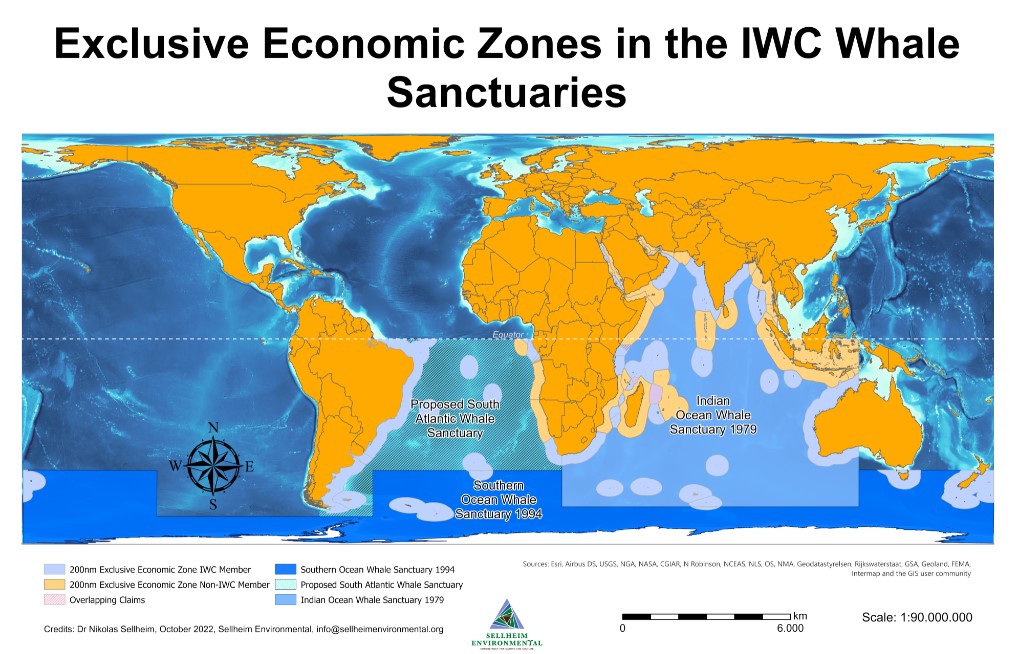
Brazil and its co-sponsors – Argentina, Ecuador, Uruguay, South Africa, and Gabon – tabled a proposal for the South Atlantic Whale Sanctuary (SAWS) as the third sanctuary established by the Commission.1 First introduced in 1998, this proposal aims to create a sanctuary that would offer enhanced protections for whales in a vast expanse of the South Atlantic. However, this proposal, despite its supporters, has also sparked considerable debate within the IWC. At IWC68 in 2022, this led to member states boycotting the vote, which lead to long-lasting debates on the quorum.2 What are the proposal’s key arguments, and why has it become such a contentious issue?
What is the South Atlantic Whale Sanctuary?
According to its proponents, the South Atlantic is a natural candidate for a whale sanctuary due to its important breeding areas in both the eastern and western parts of the ocean. Brazil and its co-sponsors emphasise that the SAWS includes a comprehensive conservation and management plan, developed in line with the recommendations of the IWC. The primary goal of the sanctuary, they argue, is the long-term conservation of cetaceans, with a focus on biodiversity and the non-lethal use of whales.
Brazil highlighted that SAWS has been endorsed by the IWC’s Scientific and Conservation Committees, meaning that the proposal meets the legal and scientific criteria required under the Convention. The sanctuary is aimed at maximising the recovery of whale populations, particularly in breeding and calving areas. The proponents argue that the creation of the sanctuary would promote international cooperation, providing a framework for coordinated research and management efforts, and contributing to food and economic security through non-lethal uses such as whale watching and eco-tourism.
Brazil’s message is clear: the sanctuary will not interfere with the fishing industry or the sovereign rights of member states. To the contrary, it will bring new economic opportunities to coastal communities and help meet international commitments to biodiversity conservation and climate change action.
Criticism and concerns
However, not all parties are convinced. Norway has been one of the most vocal opponents, stating that IWC sanctuaries only provide protection against whaling, not other threats like ship strikes, entanglements, or pollution. Norway sees the SAWS as redundant, given that a global moratorium on commercial whaling has been in place for over 30 years, and argued that creating the sanctuary would only serve to further polarise the commission.
Similarly, Antigua & Barbuda raised concerns about the sanctuary’s necessity in light of the existing moratorium. They pointed out that many whale populations have recovered and questioned what further protection SAWS would provide. In a stark warning, Antigua & Barbuda claimed that the passage of the sanctuary could trigger a “mass exodus” of countries from the IWC, leading to the “total disintegration” of the organisation. They expressed frustration that the IWC, already dealing with budgetary problems, was doubling down on such contentious issues.
St Kitts & Nevis echoed these concerns, stating that they did not see any additional benefits that the SAWS would bring, given the current health of whale populations in the South Atlantic. Saint Vincent & the Grenadines also questioned what new protections were necessary, given the success of the existing moratorium.
Voices of support
Despite the opposition, there has been strong support for SAWS from various countries. Argentina, a co-sponsor, reaffirmed its backing of the sanctuary, noting that it aligns with its long-standing support for the non-lethal use of whales. Argentina highlighted its research programmes on cetaceans and its successful whale-watching industry, emphasising the sanctuary’s potential to further boost responsible tourism.
South Africa and Ecuador also expressed strong support, both reiterating their commitment to protecting marine biodiversity. The European Union, represented by Hungary, praised the proposal for being well-considered and scientifically robust. Other countries like India, Australia New Zealand, and the United Kingdom voiced similar support, stating that the sanctuary would contribute to both cetacean conservation and the sustainable use of marine resources.
NGO perspectives
NGOs have also played a key role in the debate over the SAWS proposal. The Humpback Whale Institute and the Whale Conservation Institute both endorsed the sanctuary, arguing that it is not a polarising issue but rather an opportunity for enhanced cooperation in the South Atlantic. They stressed that SAWS would facilitate critical scientific research on the role of whales in ecosystems and generate income for coastal communities through eco-tourism and education.
However, not all NGOs were in agreement. Global Guardian Trust (GGT) took a different stance, arguing that the word “sanctuary” was being misused in this context. GGT contended that while sanctuaries are important tools for protecting key areas like breeding grounds, designating such a large area of the ocean as a sanctuary without sound scientific evidence was problematic. GGT stated that the current proposal lacks the necessary scientific backing to justify its adoption and hoped that it would not be passed.
What’s next?
The debate surrounding the South Atlantic Whale Sanctuary reflects the wider divisions within the IWC, between those focused on strict conservation and those advocating for a balance between protection and resource use. For the proposal to pass, it will need a three-quarters majority of the states present and voting at the meeting—a significant hurdle, given the sharp divide in opinions.
As the vote approaches, the fate of the South Atlantic Whale Sanctuary remains uncertain. If passed, it could represent a major step forward for whale conservation in the region, bringing new economic opportunities to coastal communities. However, the warning from Antigua & Barbuda of a possible “mass exodus” from the IWC if the proposal is approved looms large over the debate, raising the stakes even higher for this contentious vote.
- Next to the Indian Ocean Whale Sanctuary and the Southern Ocean Whale Sanctuary. ↩︎
- Sellheim, N. (2024). The challenge of the quorum at the International Whaling Commission. Journal of International Wildlife Law & Policy 26(4), https://doi.org/10.1080/13880292.2023.2294591 ↩︎
 sellheimenvironmental.org